
A good thriller relies heavily on geographical whiplash. You need that harsh contrast. A street thug holding a weapon in a damp alley is just Tuesday night on standard network television. We take that exact same threat, drag it into a vaulted ballroom suffocating under the weight of generational European wealth, and the entire psychological math changes instantly. The global film industry has exploited the world’s most exclusive luxury hotels for decades precisely because they are built to keep the ugly realities of the world completely out of sight. A luxury resort functions as the perfect cinematic arena because it flawlessly insulates its wealthy inhabitants. A disruption of that meticulous curation generates profound, inescapable anxiety. You simply cannot understate the power of a pristine tuxedo ruined by close-quarters combat.
Faking Montenegro: The Bohemian Hustle of Karlovy Vary
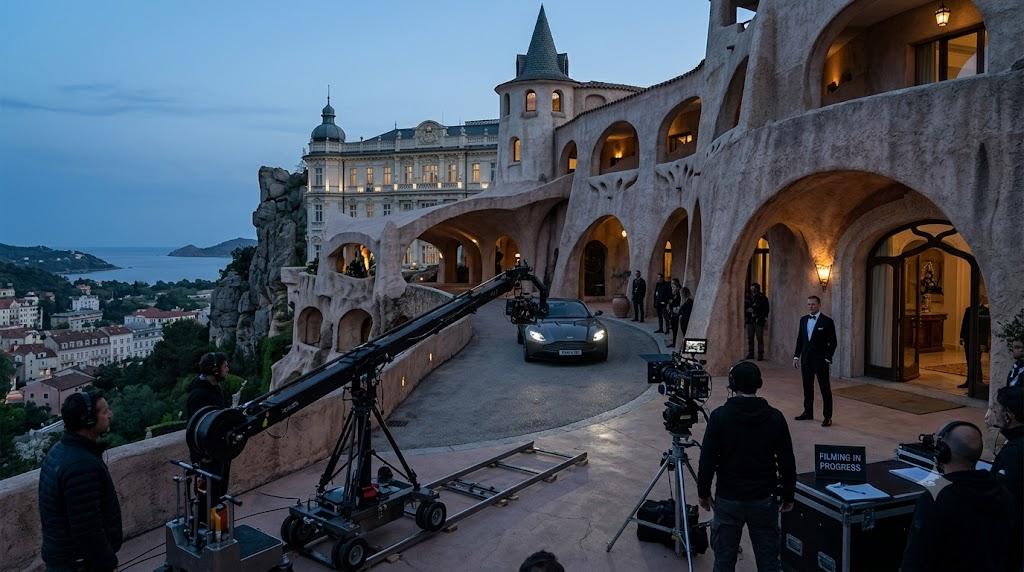
The script for the 2006 Casino Royale reboot heavily name-drops Montenegro. Industry insiders know the production logistics tell a completely different, highly pragmatic tale. Executives needed a backdrop oozing with faded, slightly lethal aristocratic charm. Studio fixers completely bypassed the Balkans. They dragged the entire multi-million dollar shoot over to Karlovy Vary in the Czech Republic instead. You look at this tight valley settlement—a place practically built on top of thermal springs—and it just radiates the exact flavor of centuries-old, slightly sinister wealth the director wanted.
The Grandhotel Pupp served as the absolute anchor for this location trickery. Two Viennese architects named Fellner and Helmer frankensteined a bunch of separate halls into one massive neo-Baroque beast back in the late 1800s. That structure became the fictional “Hotel Splendide.” Most moviegoers actually spot the front concrete driveway first. That patch of concrete is precisely where Daniel Craig’s James Bond stumbles upon his brand-new Aston Martin DBS. Directly across the Teplá River sits the Kaiserbad Spa, a stunning 1895 balneological facility heavily ornamented with Asclepius serpentine motifs. The production dressed the Kaiserbad’s exterior to serve as the titular Casino Royale. The catch? The actual interior poker games were shot hundreds of miles away on heavily controlled soundstages at Barrandov Studios in Prague. Directors needed absolute control to physically destroy the sets during the brutal stairwell fight sequences without damaging priceless historical architecture.
Sardinian Granite and Cold War Kitsch
Karlovy Vary nailed the gritty reboot vibe, but the cocaine-fueled excess of the 1970s required an entirely different geographic flex. Roger Moore’s era demanded loud, jet-set Mediterranean money to offset the absurd, high-tech lairs of his villains. Location scouts hunting for a stage during The Spy Who Loved Me hit the jackpot on the Costa Smeralda in Sardinia. The Hotel Cala di Volpe became their playground.
A billionaire royal named Prince Karim Aga Khan IV basically snapped his fingers and forced this coastline into development back in 1962. The developers handed the architectural reigns to a French guy named Jacques Couëlle. He threw standard commercial blueprints right out the window. His final design is this strange, undulating layout that feels more like a rustic, pastel-heavy fishing enclave than a billionaire’s retreat. The guy hauled in raw granite and twisted juniper wood from the surrounding hills; the resulting structure literally bleeds into the rugged local topography. The film’s massive $13.5 million budget stretched even further through clever logistical hacks. That luxurious suite featured in the movie—the one Roger Moore’s Bond occupies—was actually just the hotel’s Piano Bar. Cinematographer Claude Renoir simply repurposed the space, utilizing Couëlle’s curved archways to hide the heavy lighting rigs necessary for the shoot.
Mid-Century Miami and the Illusion of Presence
Goldfinger opens by cementing the Fontainebleau as the absolute peak of American mid-century excess. Morris Lapidus drafted this Miami Modern beast in 1954. He hated the boring, boxy functionalism of the era. The architect pivoted hard toward massive, sweeping curves instead, famously dropping a “staircase to nowhere” right in the middle of a 17,000-square-foot lobby just so guests could walk down and show off their furs.
Let’s be brutally honest for a second—cinematic presence is usually a heavily funded illusion. The sweeping aerial shots of the crescent building establish a sun-drenched atmosphere of immense wealth. You see Sean Connery getting a massage by the pool. The studio actually had Sean Connery locked down in England shooting a movie for Alfred Hitchcock. Production design legend Ken Adam possessed the terrifying job of faking that sweltering Miami atmosphere inside a freezing British soundstage. He spliced generic Florida B-roll right alongside studio close-ups of Connery. The visual sleight-of-hand was so flawless that absolutely zero ticket buyers noticed the geographic lie.
The Vegas Myth: Choreographing the Corporate Heist
American heist movies ditch the old-world manners entirely and focus strictly on corporate, impenetrable scale. Ocean’s Eleven single-handedly brought the genre back from the dead by treating the Las Vegas Strip like a genuine military target. The writers sold audiences on a wild fiction: the idea that The Bellagio, The Mirage, and the MGM Grand chuck all their weekend cash into one massive underground bunker.
That unified vault is pure Hollywood fiction, considering each property operates its own heavily fortified security grid. Steven Soderbergh made the impossible seem highly probable by hauling his entire crew right into the belly of the actual Bellagio. They dodged real tourists while framing shots across the active gaming floor. The logistics were a nightmare. Cameramen had to navigate around active high-stakes tables and a massive, glass-ceilinged botanical garden just to get their dailies. The central kinetic energy of the film relied entirely on the cast navigating those sprawling gaming spaces while dodging real surveillance cameras. Flawless precision perfectly mirrored the automated, highly engineered choreography of the Bellagio’s famous dancing fountains during the climax.
The Death of the Velvet Rope: Streaming the High-Stakes Rush
Those grand resorts in Karlovy Vary, Sardinia, and Miami share one historical constant: extreme physical exclusivity. You historically needed immense capital and strict social clearance to experience that kind of high-stakes tension. Thriller cinema allowed the global public to safely peer through the windows of the elite.
Today’s technological infrastructure has violently disrupted that dynamic. Consumers don’t need a tailored tuxedo or a private jet to the Bahamas to feel the visceral rush of a live table anymore. Modern players bypass the physical velvet rope entirely, leveraging highly optimized online entertainment offers directly from their mobile ecosystems. The industry built an immediate bridge between physical luxury and digital access through advanced live dealer technology. Providers like Evolution Gaming and Pragmatic Play operate broadcast-quality studios that perfectly replicate the atmospheric tension of the Grandhotel Pupp.
The reality is that this whole digital illusion dies on the vine if the latency slips. Let’s be real—if a player drops a digital bet and the video feed stutters for even a half-second, the tension completely evaporates, and the platform bleeds money. The industry didn’t just tweak the old systems to fix this issue; they ripped out legacy streaming protocols entirely. Engineers aggressively pivoted to WebRTC to deliver ultra-low latency streams operating at sub-250 milliseconds. A Game Control Unit (GCU) uses optical character recognition to read the physical cards in real time. The hardware then synchronizes the live broadcast with the digital betting engine in less than a single second. Your digital chip hits the virtual felt at the exact millisecond the physical card flips over in a broadcast studio three thousand miles away.