

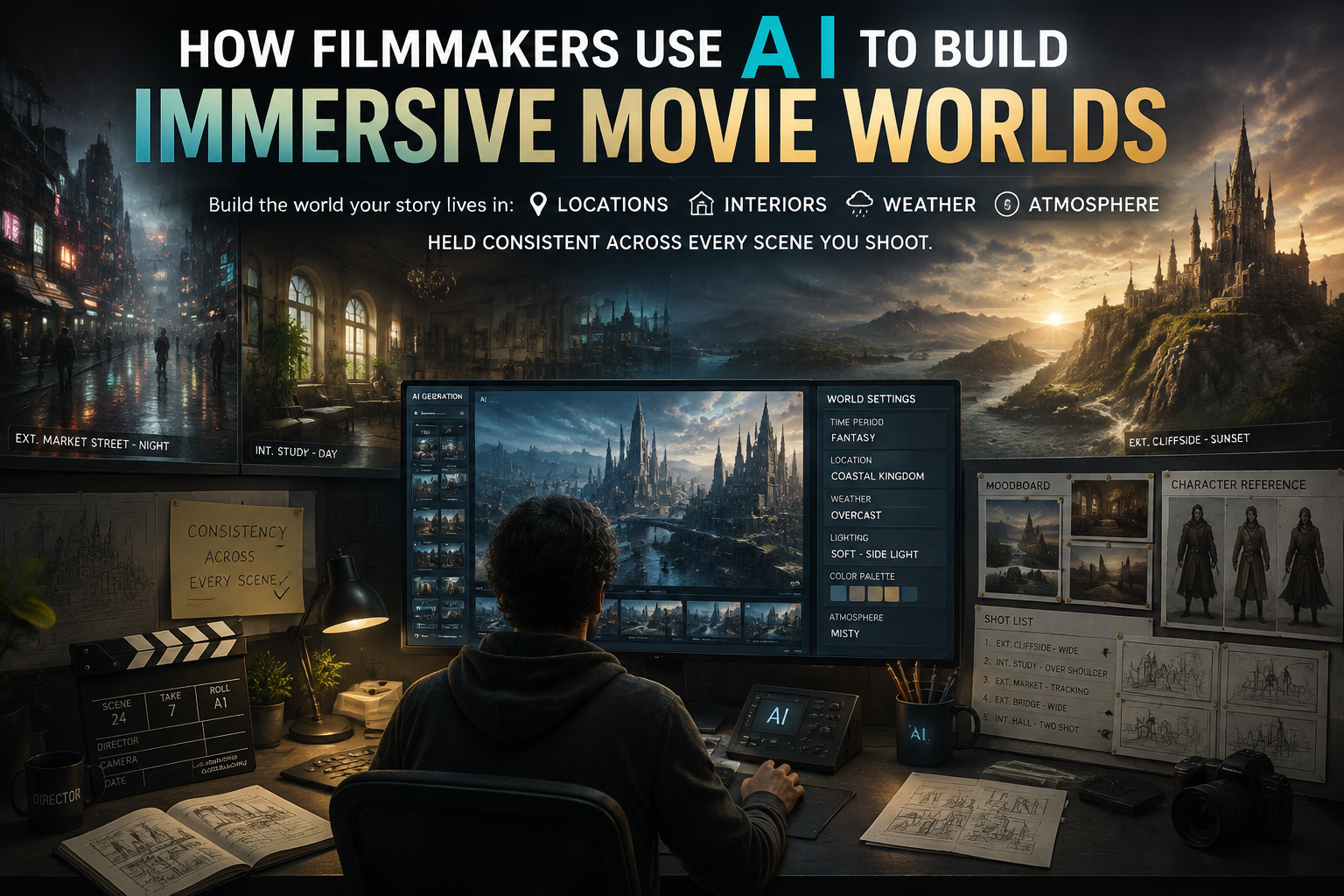
AI filmmaking helps directors design locations, interiors, weather, lighting, and atmosphere as parts of one connected movie world. The strongest approach starts with clear visual rules, then carries them through storyboards, shots, effects, and editing. AI agents can also hold project context across scenes, which helps filmmakers preserve the look and logic of a world as the story grows.
Building a believable movie world is rarely about creating one spectacular shot. The harder task is making every room, street, costume, light source, and weather condition feel connected. This is where AI filmmaking is becoming useful for directors and production teams.
The shift is already reaching larger screens. Forbes reported that finalists from the 2025 Runway AI Film Festival were set to screen at 10 IMAX locations across the United States, with 40 screenings planned in total.
For filmmakers, the useful question is not simply whether AI can create a beautiful frame. It is whether that frame can belong to a world that remains believable for an entire story.
AI filmmaking works best when filmmakers define the world first, then carry its rules through every stage of production.
A strong process starts with a world bible, builds visual references from it, and checks every scene against those rules. The aim is not endless visual variation. It is a world that feels intentional from the opening shot to the final cut.
How does AI filmmaking build worlds?
AI filmmaking helps directors turn story ideas into a visual system. They can define architecture, weather, color, lighting, geography, props, and camera rules before creating final scenes. Those decisions then guide later images and shots, helping different parts of the film feel like they belong in the same place.
Start by defining the rules of the environment. If a story takes place in a rain-soaked coastal city, the buildings, streets, clothing, light, and sky should support that idea.
A practical world brief might cover:
- Time period and geography
- Architecture and interior materials
- Season and weather
- Color and contrast
- Main light sources
- Recurring props
- Camera movement rules
Filmmakers can first turn these ideas into an AI mood board and then build an AI storyboard. This makes the visual direction easier to judge before more detailed scene work begins.
Production design starts with world rules
Production design gives a movie its physical logic. AI can help explore that logic quickly, but filmmakers still need to decide what belongs in the story and why.
Think of a movie filming location as more than scenery. Its size, layout, surfaces, windows, and available light all affect how characters move through the scene.
AI filmmaking can help teams explore different versions of that space before locking a direction. The same room might feel warm and lived in during one story or cold and isolated in another.
Invideo Agent can support this process by keeping scripts, character references, locations, and established visual rules inside the same project context. Its memory can help carry location and style decisions between shots and later sessions.
How do filmmakers keep worlds consistent?
Filmmakers can improve world consistency by creating approved reference images for each major location and treating them as visual anchors. New shots should follow the same spatial layout, materials, lighting logic, scale, and color treatment. When the environment changes during the story, filmmakers can create a new reference state for that change.
A useful location sheet can show the room or environment from several useful viewpoints. Include entrances, windows, key surfaces, major props, and the main light direction.
You can also define different states. A street before a storm should have one reference set. The same street after flooding may need another.
Invideo Agent takes a similar approach to environment locks, character states, visual grammar, and continuity across scenes. It also supports role-based agents that can focus on areas such as cinematography, casting, storyboards, and production design while working from shared project information.
This AI Agents for Filmmaking masterclass goes deeper into this production approach and shows how filmmakers can direct agents through a longer film workflow rather than treating every shot as an isolated prompt.
AI agents can work like departments
Traditional productions divide responsibility between departments. Agent-based workflows can mirror part of that structure by giving different AI agents focused jobs.
Invideo Agent supports specialized agents for tasks such as storyboarding, cinematography, costume, and production design. Itcan work on projects where six to eight agents can work in parallel, while a creative producer agent holds the wider film context.
That structure can be useful for immersive world building because one creative decision often affects several departments. Changing a location from afternoon to night may affect lighting, costume contrast, exterior views, atmosphere, and later shots.
Invideo Agent 2 is invideo’s recent launch, a frontier intelligence agent for serious creative work. Its project memory can hold earlier decisions, while expert agents can share project updates and read materials such as scripts, PDFs, reference documents, and footage. This is designed to help longer productions keep connected decisions in context.
How can AI VFX extend worlds?
AI VFX can extend a real set, alter an environment, or build elements around filmed performances. A useful approach is often hybrid. Filmmakers can preserve practical performances or important physical details, then use generated imagery for wider environments and effects while matching the established light, color, and visual direction.
For example, an actor could perform beside a real doorway while the surrounding space becomes a much larger science fiction station. A practical window view could also become a new exterior without changing the performance inside the room.
Clean subject separation also becomes important when a filmed performance needs to sit inside a different environment. Key Lab, part of invideo’s VFX House, can remove background from video while working around motion, hair, and detailed edges frame by frame. It helps in clean cutouts at cinematic quality that hold at full resolution, which can help when combining live performances with generated environments for cinematic short films.
Conclusion
AI filmmaking gives directors another way to explore and maintain the world behind a story. Its strongest role is not creating endless unrelated visuals. It is helping filmmakers carry decisions about location, interiors, weather, lighting, characters, and atmosphere across many connected scenes.
A good starting point is one important location. Define its visual rules, build references, storyboard a short sequence, and test whether those details remain recognizable across several shots. The creative choices still belong to the filmmaker. AI helps carry those choices through more of the production.
Frequently Asked Questions
What is AI filmmaking?
AI filmmaking means bringing AI systems into one or more parts of film production. This can include concept development, storyboarding, environment design, visual generation, effects, sound, or editing. For world-building, its main value is helping filmmakers explore visual ideas and carry approved choices into later scenes while keeping the director responsible for the final creative direction.
Can AI create consistent movie locations?
Yes, especially when filmmakers provide clear visual references instead of describing the location again for every shot. Location sheets can define architecture, materials, doors, windows, lighting, important props, and scale. Project memory can then help preserve those details across later scenes.
How does AI help production design?
AI can help production designers explore possible interiors, architecture, colors, materials, weather, and lighting before final production decisions are made. Storyboards and visual reference boards also make different options easier to compare. The designer still sets the rules of the world, while AI provides another way to test how those rules could appear on screen.
Do AI agents replace film crews?
AI agents are better understood as another production layer rather than a replacement for filmmaking decisions. A director can assign agents focused jobs while remaining responsible for story, taste, performance, and final approval.
What should filmmakers build first?
Start with a short world bible for one important location. Define its geography, architecture, lighting, weather, color, key objects, and overall mood. Next, create reference views and storyboard one short scene from several camera positions. This gives you a practical test of whether your AI filmmaking process can preserve a believable environment before expanding into a larger production.
