

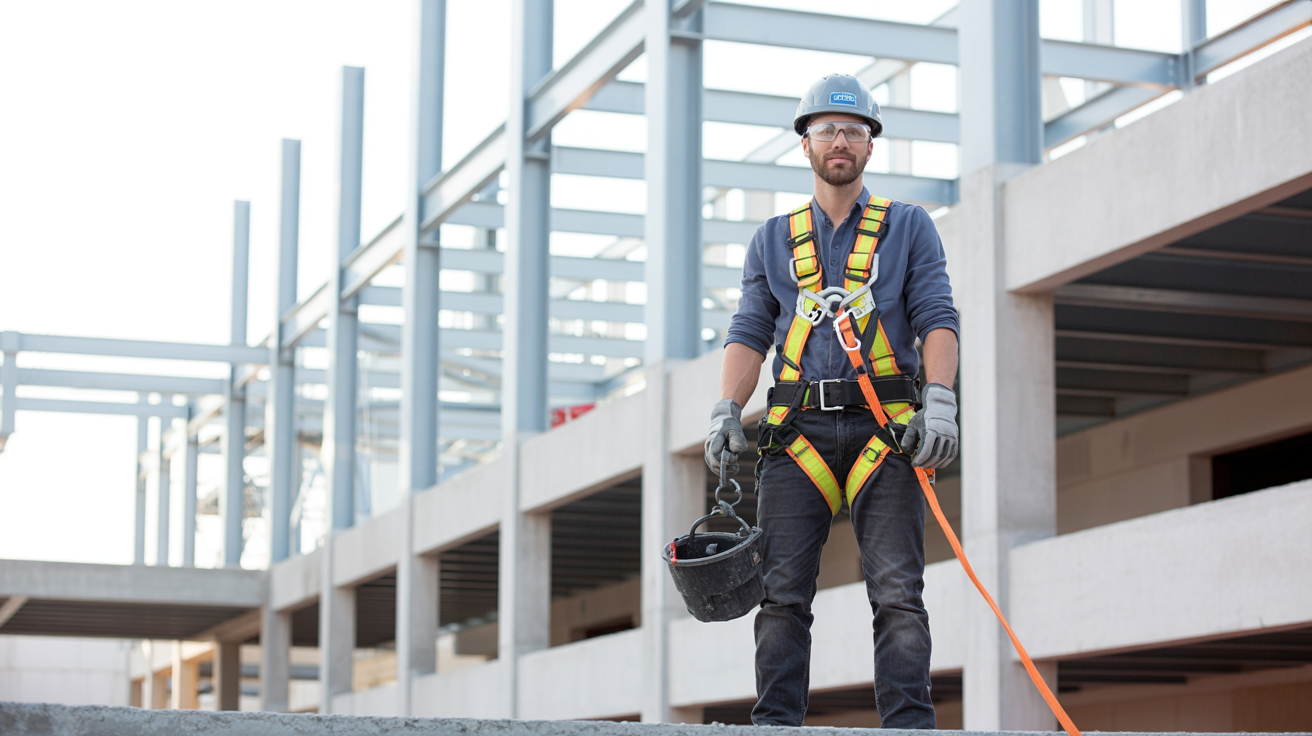
Working at height isn’t limited to skyscrapers or steel erection crews. It shows up in routine tasks across construction, maintenance, warehousing, utilities, and industrial operations, often in ways that feel “low risk” until something goes wrong.
The question isn’t just whether a high-quality safety harness is available on-site. It’s whether the job actually requires one and the worker understands how it fits into a complete fall protection strategy.
Fall protection is too often reduced to a checkbox: harness on, work begins. In reality, that mindset misses the bigger picture.
Harnesses are only one part of a broader system designed to prevent falls, arrest falls, and ultimately reduce injury severity. Knowing when and why a harness is required (and what else must be in place) is what separates compliant job sites from truly safe ones.
When Does a Job Require a Safety Harness?
The short answer: Any time there’s a risk of falling from elevation and no passive protection (like guardrails) fully eliminates that risk. In the U.S., regulatory guidance from the Occupational Safety and Health Administration (OSHA) establishes trigger heights and conditions in which fall protection is required. While exact thresholds vary by industry, the most commonly cited rules are:
● General industry: Fall protection required at 4 feet.
● Construction: Fall protection required at 6 feet.
● Longshoring: Fall protection required at 8 feet.
But focusing strictly on height thresholds can be misleading. Many serious injuries occur below these limits due to poor conditions, unstable surfaces, or improper equipment use. A more accurate approach is to assess exposure to fall hazards, not just elevation.
Common Scenarios Where Harnesses Are Required
Workers typically need safety harnesses in situations like:
● Working on open-sided platforms without guardrails
● Operating from aerial lifts or boom lifts
● Performing tasks on rooftops without perimeter protection
● Climbing or working on ladders in extended or unstable positions
● Navigating steel structures, scaffolding, or framework
● Conducting maintenance on machinery or equipment at height
In these cases, relying on balance, experience, or “being careful” isn’t a control measure. If a fall hazard exists and can’t be eliminated, reliable fall protection equipment becomes mandatory.
A Safety Harness Is Not a Complete System
One of the most common misconceptions is that a harness alone provides protection, but it doesn’t.
A safety harness is just one component of a personal fall arrest system (PFAS). Without the rest of the system properly configured, the harness can’t do its job.
The Core Components of a Fall Protection System
A complete system typically includes:
● Anchorage point: A secure structure capable of supporting required loads
● Connector: A lanyard or self-retracting lifeline (SRL) that links the worker to the anchor
● Body support: The safety harness itself
● Deceleration device: Absorbs energy during a fall to reduce forces on the body
Each component must be compatible and properly rated. Failure in any one part compromises the entire system. This is where many jobsites fall short. Equipment may be present, but not correctly selected, installed, or used in combination. For example:
● A harness attached to an improper anchor point is ineffective.
● A lanyard that’s too long can result in ground impact before arrest.
● Missing energy absorption can lead to excessive forces on the body.
Understanding how these elements work together is critical.
Job Demands vs. Equipment Presence
A more useful question than “Do we have harnesses?” is: “Does this job require fall protection, and is the system matched to the risk?”
That shift matters.
Risk-Based Thinking on the Jobsite
Different tasks create different fall profiles:
● Vertical exposure: Working near edges or openings
● Swing fall risk: Lateral movement away from anchor points
● Clearance limitations: Insufficient distance to safely arrest a fall
● Mobility requirements: Tasks requiring frequent repositioning
Each of these factors influences what type of fall protection equipment is required, not just whether a harness is worn.
For example:
● A worker installing rooftop HVAC units may need a horizontal lifeline system to maintain mobility.
● A warehouse technician accessing elevated racks might require a self-retracting lifeline to minimize fall distance.
● A maintenance worker in a confined elevated space may need specialized anchorage solutions.
Why Worker Awareness Matters
Even with the right equipment in place, outcomes depend heavily on worker understanding. A harness doesn’t prevent a fall. It helps manage what happens after a fall begins. That distinction is essential.
Key Concepts Every Worker Should Understand
1. Fall Clearance
Workers need to know how much space is required to safely stop a fall. This includes:
● Lanyard length
● Deceleration distance
● Harness stretch
● Worker height
Misjudging clearance can result in ground or lower-level impact, even when connected.
2. Proper Fit and Adjustment
An improperly fitted harness can:
● Increase injury risk
● Shift during a fall
● Fail to distribute forces correctly
A harness should be snug, with leg straps and chest straps correctly positioned. Loose gear is extremely dangerous.
3. Anchor Point Selection
Not all structures are suitable anchors. Workers must be trained to identify:
● Approved anchor locations
● Load-rated structural points
● Improvised anchors to avoid
Attaching to guardrails, piping, or non-rated structures is a common (and serious) error.
4. Inspection Before Use
Fall protection equipment must be inspected before each use. Workers should look for:
● Frayed webbing
● Damaged stitching
● Corrosion or deformation in hardware
● Signs of previous fall loading
If there’s any doubt, the equipment should be removed from service.
The Role of Fall Protection Equipment in Different Industries
Fall hazards aren’t limited to one type of work. The role of fall protection equipment varies depending on the environment, but the underlying principles remain the same.
Construction
● Constantly changing environments
● Temporary structures and incomplete guardrails
● High exposure to edge work
Harnesses are often used in combination with lifelines and anchor systems to maintain flexibility as the site evolves.
Maintenance & Facilities
● Intermittent exposure to height
● Work on rooftops, equipment platforms, and access points
● Often performed by non-specialist workers
Here, the challenge is ensuring workers who don’t operate at height daily still understand how to use safety harnesses correctly.
Warehousing & Logistics
● Elevated picking systems
● Mezzanines and racking structures
● Equipment like order pickers and lifts
Fall protection is often integrated into equipment design, but harness use still plays a role in specific tasks.
Industrial & Utilities
● Complex structures (towers, tanks, pipelines)
● Variable anchor options
● Exposure to environmental factors (wind, weather)
Systems here often require more advanced planning, including engineered anchor solutions and specialized connectors.
Common Mistakes That Put Workers at Risk
Even experienced crews make errors that compromise fall protection systems. The most frequent issues include:
● Treating harnesses as standalone protection
● Using incorrect or unverified anchor points
● Ignoring fall clearance calculations
● Failing to inspect equipment before use
● Using damaged or expired gear
● Improper training or assumptions of competency
These aren’t edge cases. They’re recurring problems across job sites.
Moving Beyond Compliance
Meeting regulatory requirements is the baseline. It’s not the goal. A jobsite can be technically compliant and still expose workers to unnecessary risk if fall protection isn’t properly understood and applied.
What Better Looks Like
● Task-specific risk assessments before work begins
● System-based thinking (not just equipment-based)
● Ongoing training and reinforcement
● Clear accountability for inspection and setup
● Worker involvement in safety planning
Organizations that take this approach treat fall protection as an operational priority, not just a safety requirement.
