

This is one thing that is surprising to most people who just purchased solar:
The power goes out. It is still bright outside. Your panels are still on the roof.But your house is dark.
It feels broken. It isn’t.
Most home solar systems automatically shut down when the grid goes out. Not a panel issue, but a safety requirement.
Why? It is imperative that crews know that a downed power line is dead. So the grid tied inverter cuts off your grid and ceases to provide power.
The panels could be in full sun, but without the grid that energy will not be able to run your house. And here’s the part many solar owners miss:
Having solar doesn’t automatically mean having backup power.
If you want your lights to stay on during a blackout, the key isn’t just the panels.
It’s the inverter and the battery working with it.
How Does a Hybrid Solar Inverter Keep the Lights On?
The solar panels are not all you need to make a dependable home power system. The panels produce electricity, and the hybrid solar inverter makes the decision on how the electricity will be utilized, stored, or provided to the home.
If the grid is on, the inverter can help to drive domestic loads and charge the battery. If the power grid fails, the grid can be switched to store solar power to run certain appliances. This is why you can’t determine with the number of panels alone whether you will have power in case of an outage. The hybrid solar inverter along with the battery combination is just as crucial.
| Setup Type | How It Works | During a Blackout |
| Grid-tied | Solar works with the utility grid | Usually shuts down for safety |
| Off-grid | Solar and batteries operate without the grid | Keeps running while stored energy is available |
| Hybrid | A hybrid solar inverter manages solar, batteries, and grid power | Can keep selected loads running during an outage |
A hybrid solar inverter is the crucial component of the solar inverter system with homeowners who wish to use solar energy but with backup capabilities. Installed in several different capacities, including 3 kW, 5 kW, or 10 kW, the size of the unit will be determined by the electrical loads required to continue functioning in the home and the power requirements.
A hybrid solar inverter differs from a simple grid tied inverter by its ability to control electricity from multiple sources. It can power a house’s loads, store any surplus electricity in the battery, use solar energy, and switch to battery power in the event of a blackout.
This means that the inverter is much more than just a solar energy conversion device. It serves as a control point between the panels, battery, grid, and home and helps to ensure that critical loads are operating when the power from the grid is off.
What happens when the grid goes down?
Suppose the electricity fails at 2 pm.
- Your Solar Panels are generating power.
- Your refrigerator is switched on.
- Your Wi-Fi is working.
Then the grid disappears.
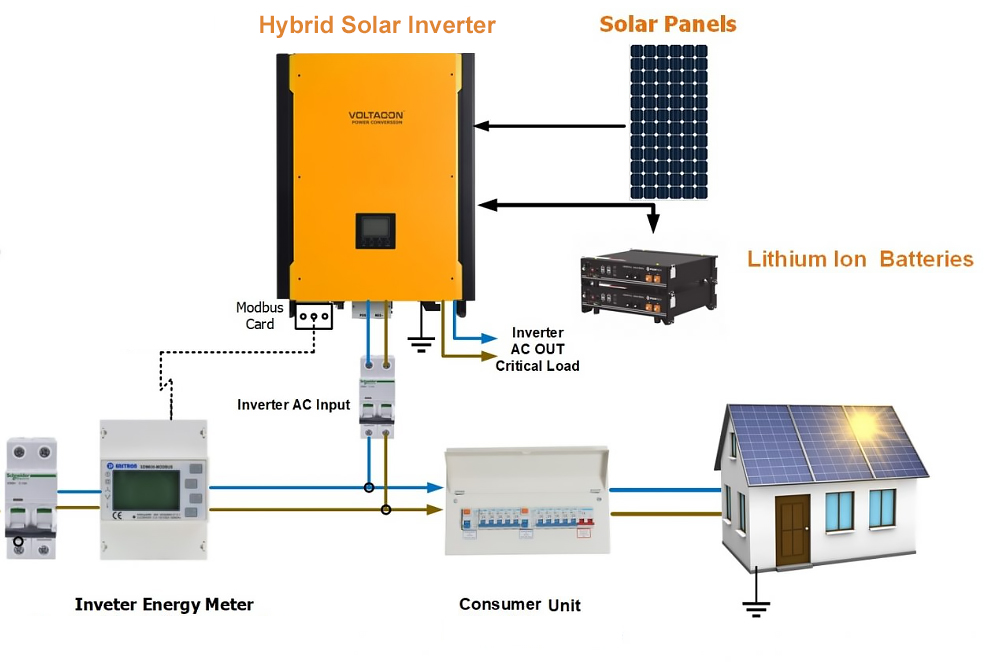
A properly configured backup system detects that loss of grid power and isolates the home from the utility grid. That isolation has to happen before the system can safely supply your house independently.
Once the home is separated from the grid, the inverter can operate in backup mode. At this point:
- The battery becomes an available source of stored energy.
- In some cases, if sunlight is available, the solar panels can continue to contribute energy to the system, depending on the design and operating conditions of the system.
- The inverter is used to control the available power and to provide power to the home during an outage.
So instead of:
Grid → Home
you can have:
Solar + Battery → Home
And when the grid comes back, the system can reconnect according to its programmed controls.
These are all important, but none of them should require a run-out to the neighborhood utility meter and a flipping of a giant switch every time the neighborhood loses power. The system is designed to automatically manage the transition.
How quickly that happens depends on the equipment and configuration. Some systems are designed for extremely fast transfer, while others may allow a short interruption.
So if you’re expecting your home to behave exactly like a UPS for a server room, don’t assume every hybrid system does that. Check the actual transfer specifications before choosing a system.
What “Hybrid” Actually Means
Strip away the marketing language, and a hybrid inverter is basically several power-management devices working together in one system.
Here are the actual results it provides:
- Converts DC electricity to AC electricity: Solar panels generate DC power, while most homes generate AC power. The solar inverter transforms the electricity generated by the solar panels into electricity that is usable by your home.
- Controlling the battery: If your solar panels generate more electricity than you use at home, the system can store extra electricity in the battery for use later (depending on the system’s settings and economics of the installation).
- Manages your power sources: A hybrid inverter can be configured to decide where your home gets its electricity from based on the system’s settings.
- How the system functions during an outage: In an outage the inverter cannot run the system just as a grid-tied inverter would.
- Creates a controlled backup environment: The system must first isolate your home from the utility grid before supplying backup power. Once isolated, the inverter can manage the available solar and battery power for the home’s backup loads.
For example:
Powering your home from solar energy and maintaining battery charge at the same time!Solar power to power your home and battery at the same time!
There is no functioning grid to synchronize with.
That’s why it’s important to state that a hybrid inverter is NOT just another inverter.
It is the traffic controller that determines the source of your home’s electricity, where it is sent, and which sources are used and when.
What Actually Needs to Stay On?
This is where homeowners can make the system unnecessarily expensive.
During a blackout, you probably don’t need your entire house running exactly as normal.
You need the essentials:
- Refrigerator
- Lights
- Wi-Fi
- Security cameras
- Computer
- Fans
- Water pump
- Essential medical equipment
Then come the heavy loads:
Central AC. Electric heaters. Water heaters. Ovens. Dryers. EV chargers.
These can consume a lot of power and may require a much larger inverter and battery.
So instead of buying a massive battery, ask a simpler question:
What actually needs to stay on?
Sometimes, the smartest backup system isn’t the biggest one.
It’s the one size that matters.
Where Can a Hybrid Solar Inverter Be Useful in Daily Life? In addition to being helpful during a power outage, a hybrid solar inverter can also be used to reduce electricity bills. It can also be used to help control the consumption of electricity in homes and small businesses that are dependent on the stable supply of electricity.
- If your house experiences frequent power failures or load shedding, a battery system can be installed in a hybrid setup to maintain the supply of electricity to the essential items in your home, like lights, fans, refrigerators, and internet equipment.
- With time of use pricing, the solar battery can be charged when electricity is cheaper and used during periods of higher electricity rates.
- Short power outages A brief interruption to the power could end a video call, turn off your desktop computer, or cause you to lose unsaved work. A hybrid system can rely on batteries to maintain critical systems during a power outage.
- For home offices and small businesses If you have an office at home or a small business, it can be important to keep equipment (like computers, networking devices, security systems, or refrigeration) running. A backup power supply can help minimize disruptions during a power outage.
- In some configurations EV charging can also be supported by a properly sized hybrid system. However, this type of EV charger can consume a lot more power than your regular appliances require, which means the inverter, battery, and solar array must be appropriately sized to deliver the power.
The key concept is easy: If you use electricity in a way that makes sense, that’s when a hybrid solar inverter is more useful. The right system can not only give you back-up power, but it can also help you utilize solar power more efficiently.
What Happens on a Cloudy Week?
This is where the notion of “solar means unlimited free electricity” begins to unravel.
A solar system generates energy in direct correlation with the amount of sun’s radiation that is available, which means that the energy it generates varies depending on the time of day and the weather.
- On a sunny day: When the sun is shining your solar panel and battery could generate a good amount of electricity.
- On a cloudy day: There can be less energy available on the day to run your home or recharge the battery even if solar is producing.
- In a brief outage: Your battery can easily make up the difference, particularly if you have relatively small essential loads.
- During a long outage: Things get more challenging. If the battery keeps losing energy while solar production remains low, your available power will eventually decrease.
Under normal conditions, the grid can fill that gap. But when the grid is also down, you can’t rely on it to provide extra electricity.
That’s why serious backup planning shouldn’t be based on one perfect sunny afternoon. You need to think about the conditions in which you actually expect the system to operate:
- How long outages usually last
- How much energy your essential appliances consume
- How much solar power your panels can produce in poor weather
- How much energy your battery can store
A hybrid system gives you flexibility and backup options.
It doesn’t give you unlimited energy.
Sizing It Right (This Is Where Most Systems Underperform)
A hybrid inverter alone does not guarantee backup power.
The inverter, battery, backup loads panel or transfer equipment, and islanding controls all need to be configured to work together.
The battery provides stored energy. The inverter determines how that energy is converted and delivered. The backup configuration determines which parts of the house actually receive it.
A few numbers are worth checking before buying:
- Total household load. Add up what actually needs to run during an outage, not everything in the house. A fridge, some lighting, a router, and a pump is a very different load from an entire house running normally.
- Inverter capacity (kW).The inverter must have sufficient PV input capacity to power the PV array and sufficient AC output capacity to power the loads that you are planning to run on an outage, including start-up surges.
- Battery capacity (kWh). This will dictate the amount of stored energy available and the duration of essential load operation. Actual run time depends on usable capacity, efficiency and depth-of-discharge.
- Surge loads. When they turn on, refrigerators, pumps, compressors, and AC units draw more energy for a short period of time. An inverter that looks fine based only on average running load can struggle when one of these motors kicks on.
The first and fourth of these numbers are the ones that get you a “good looking” system in the spreadsheet and a bad one in the blackout.
Does It Work for Your House?
This is a significant difference.
While it is technically capable of providing backup power, the system may not be a good choice for your home.
For example:
- Bigger battery, smaller inverter: The battery could power an air conditioner for 8 hours, but the inverter may not be able to start up the AC.
- Strong inverter, small battery: The inverter is able to power your appliances but the battery may wear down a lot quicker than you think.
- Large battery, limited backup circuits: You may have plenty of stored energy, but only a few circuits are connected to the backup output.
- Correctly sized equipment, local restrictions: Even if the system is properly sized, local electrical requirements may affect how and where it can operate.
The equipment has to work together.
That’s why comparing solar systems by panel count alone doesn’t tell you much.It’s possible for two houses to have the same number of panels but have entirely different backup options.
It’s the synergy of the solar panels, battery, solar inverter, backup circuits, and local electrical needs that matter most.
What Trips People Up After Installation
- Assuming more panels means more backup power. Panels only produce during daylight. At night, your available backup energy comes from the battery.
- Ignoring efficiency losses. Energy conversions aren’t 100% efficient. A system designed with no margin can deliver less usable energy than the headline numbers suggest.
- Skipping local interconnection rules. Utilities can have specific requirements for how hybrid systems connect, disconnect, and export power. Ignore those requirements and installation can become much more complicated.
- Treating the battery as “extra.” If backup power is the goal, battery storage isn’t a side accessory. It’s a core part of the system.
- Forgetting startup loads. A refrigerator might use relatively little once it’s running, but its compressor can demand a short surge when it starts.
- Trying to back up everything. More backup loads mean more required inverter power and more battery capacity. Sometimes a carefully selected essential-load setup makes far more sense than trying to keep the entire house running normally.
Is Hybrid Actually the Right Call for You?
A hybrid solar inverter is not the right choice for every home. If outages are rare, electricity rates are flat, and your main goal is to lower your bill, a standard grid-tied system may be simpler and more affordable.
Hybrid makes more sense when you need backup power or better control over energy use, especially with frequent outages, load-shedding, peak electricity prices, critical appliances, remote work, or a home business.
The best approach is to start with what you need to keep running when the grid goes down. Identify your essential loads, calculate their power needs, choose the right inverter and battery, decide which circuits need backup, and then determine the solar capacity required.
