

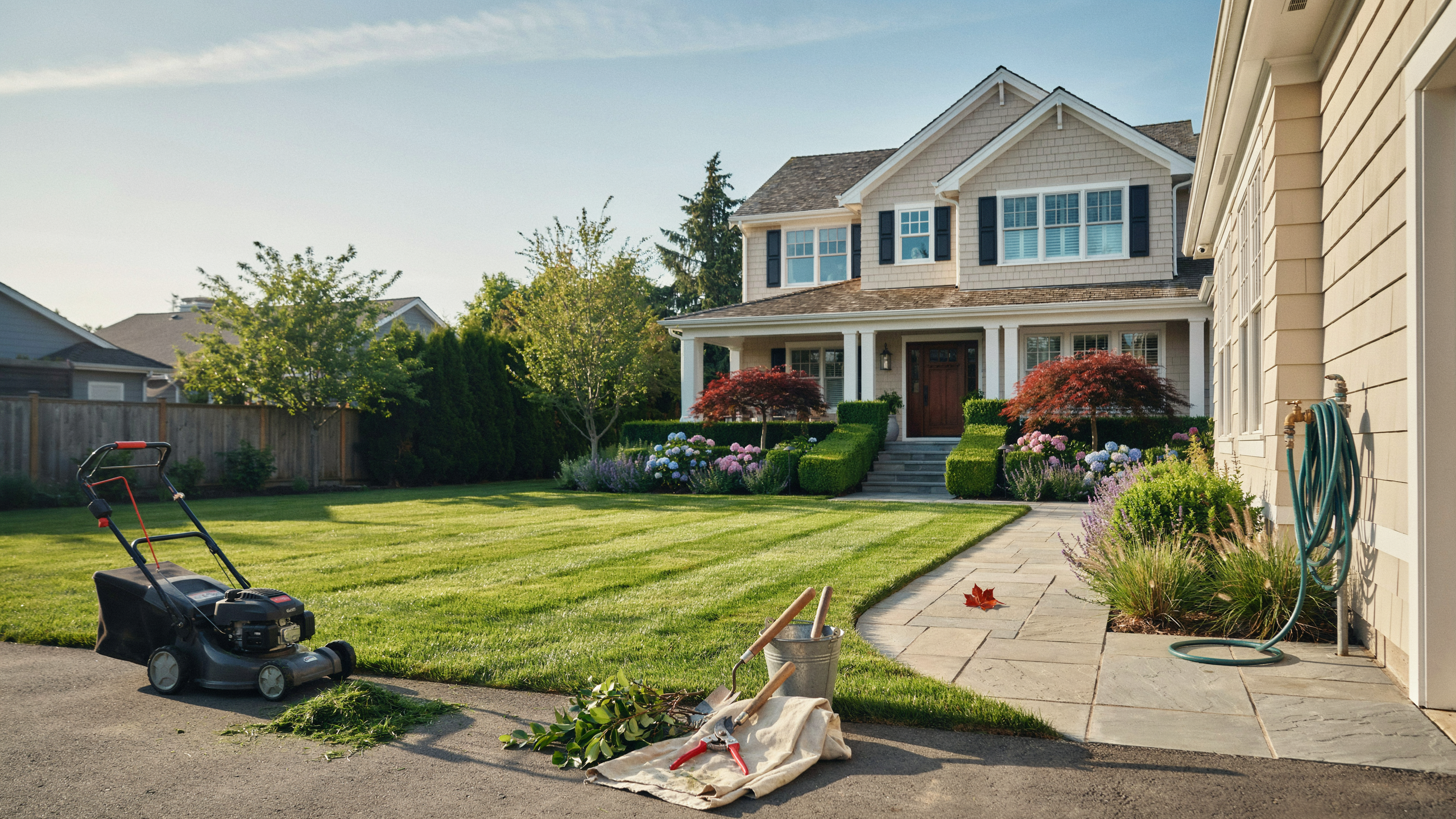
There’s a particular kind of lawn that shows up again and again in films and television. Flat, uniformly green, edged like a sheet of paper, with no bare patches near the driveway and no yellow ring where the dog sits. It reads as normal. That’s the whole point — the yard is supposed to look like the default condition of suburban life, the baseline every family achieves without trying.
It isn’t. That lawn is a manufactured object, closer to a stage prop than to anything growing on its own. Behind the fifteen seconds it appears on screen sits a schedule of feeding, watering, cutting, and repair that runs for months. Homeowners who compare their own grass to that image are measuring themselves against a standard built by people who were paid to hit it. Understanding what actually produces that look makes it far easier to decide how much of it is worth chasing.
What the Camera Actually Sees
A yard in a film isn’t photographed the way you see your own from the porch. It’s lit, framed, and often shot from a low angle that flattens the turf into a solid plane of color. Small imperfections vanish. Large ones become impossible to ignore.
Continuity Rules the Yard
Scenes shot on the same lawn may be filmed weeks apart. Grass grows during that gap, sometimes unevenly, sometimes in patches that catch the light differently. Continuity crews can’t allow that. So the lawn gets cut, watered, and fed on a fixed rhythm designed to hold one appearance for the entire shoot — not to keep the grass healthy over years, but to freeze it in place for a production window.
Color Grading Pushes It Further
After filming ends, the footage passes through color correction. Greens get saturated. Shadows get deepened. The lawn that was already unusually uniform ends up a shade or two beyond anything a real yard produces in ordinary daylight. Viewers absorb that final image as the reference point. Nobody sees the raw footage, which usually looks considerably more ordinary.
That gap between what was planted and what was broadcast is where most homeowner frustration begins. The work that closes it is unglamorous and constant.
The Feeding Schedule Behind the Color
Deep, even green is not a matter of watering more. It comes from nutrition, and specifically from nitrogen, which drives the shoot growth and leaf color that read so well on camera.
Nitrogen Does the Visible Work
Grass pulls nitrogen out of the soil faster than most soils can replace it, especially in a lawn that gets mowed constantly and has its clippings hauled away. Starve it and the change is obvious within a season. Blades thin out. Color drifts toward pale yellow-green. Soil starts showing through at the base of the canopy. University extension programs are direct about this — guidance from the University of Minnesota Extension ties recommended nitrogen amounts to soil organic matter and the level of upkeep a homeowner actually wants, rather than treating one rate as correct for everyone.
Timing Beats Volume
The instinct is to dump more product on a struggling lawn. That’s usually the wrong move, and sometimes an expensive one. Excess nitrogen produces soft, fast growth that’s more vulnerable to disease, and what the grass can’t absorb tends to leach downward or wash off hard surfaces into storm drains. Set-quality turf comes from splitting applications across the growing season and matching them to when the grass is actively growing — typically mid-to-late spring, late summer, and late fall for cool-season grasses. Getting that calendar right takes either careful record-keeping or a contractor, which is why many homeowners aiming for a consistently even lawn end up hiring lawn fertilization services rather than guessing at rates and dates themselves. A soil test at the start tells you what’s actually missing. Skip it and you’re fertilizing blind.
Feeding is only one line item, though. The rest of the schedule is just as relentless.
Water, Mowing, and the Rest of the Invisible Work
The Water Bill Nobody Mentions
Fertilizer without water is close to useless — nutrients need moisture to move into the root zone. Keeping a lawn at picture condition through a dry stretch means real volume, and the numbers scale quickly. The EPA notes that residential outdoor water use in the United States runs to roughly 8 billion gallons a day, mostly for landscape irrigation, and that the average household uses more water outside than on showering and laundry combined. A production can absorb that cost for a few weeks. A family paying a monthly bill in a region with watering restrictions cannot, at least not indefinitely.
Mowing Height Is a Design Choice
Screen lawns are usually cut short, because short grass photographs as a smooth surface. Short grass also has shallower roots, dries out faster, and gives weeds more light to work with. Cutting higher produces a lawn that’s tougher and cheaper to maintain but slightly shaggier in appearance. That trade-off is invisible to viewers and unavoidable for homeowners. Most people who chase the short-cut look end up watering more to compensate.
The Edges Do a Lot of the Lifting
Crisp lines along the driveway, the walkway, and the flower beds account for much of the impression of tidiness. Edging is fast, requires no chemicals, and produces a disproportionate visual return. It also has to be redone every few weeks to stay sharp.
Pests, Weeds, and the Repairs That Never Air
A production lawn gets inspected. Grubs feeding on roots, fungal patches, chinch bugs, crabgrass moving in along the warm strip beside the pavement — all of it gets caught early and dealt with before it shows up in a frame. Regular feeding helps here too, since denser turf crowds out weeds and recovers faster from damage, a point Purdue Extension illustrates plainly in its side-by-side comparison of fertilized and unfertilized turf.
When something does go wrong on a set, the fix is often replacement. Damaged sections get cut out and sod gets laid in. That option exists because the yard has a budget attached to it. Most households repair by overseeding and waiting, which works, but takes a season rather than an afternoon.
What This Means for a Real Yard
The useful conclusion isn’t that the screen version is fake and should be ignored. It’s that the look is a product of inputs, and you can choose which inputs you’re willing to supply. Feeding on a sensible schedule delivers most of the color. Consistent mowing and edging deliver most of the tidiness. Watering deeply and less often builds roots that survive a bad August. Everything past that — the flawless uniformity, the total absence of a weed — costs far more per unit of improvement than the earlier steps did.
Deciding where to stop is the actual skill. Someone who gets the first three things right and accepts a few imperfections will have a yard that looks good year after year without organizing their weekends around it.
The Bottom Line
The lawns that set the standard were never meant to be sustainable. They were built to look a specific way for a short period, maintained by people working from a schedule and a budget, then polished further in post-production. Judging a real yard against that image guarantees disappointment, because the comparison leaves out everything that made the image possible.
Knowing what’s underneath changes the goal from imitation to something more practical. Feed the grass properly, cut it sensibly, water it with intention, and handle problems while they’re small. The result won’t be identical to what appears on screen. It will be a lawn that holds up on its own terms, which is a better outcome than the one most people are aiming for.
