

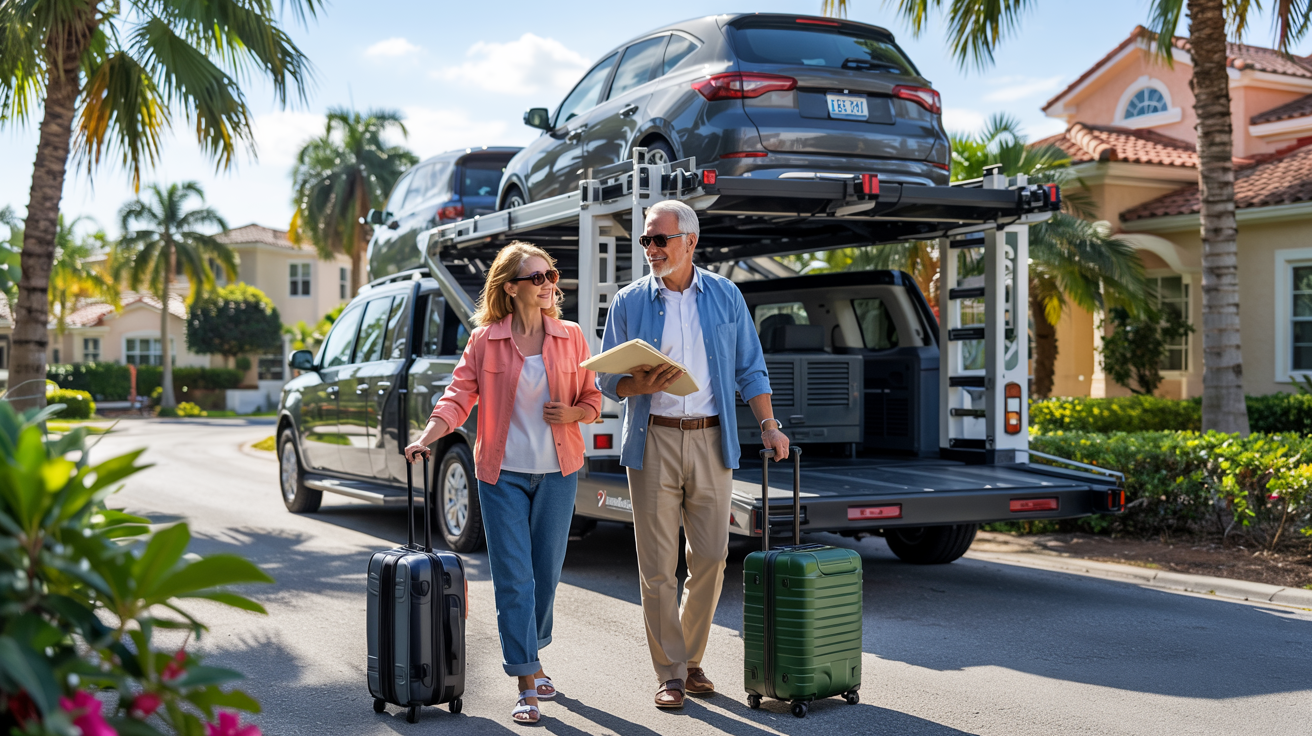
Every snowbird hits the same fork in the road, usually right around the first cold snap up north. Drive the car down (or back), or pay someone to haul it? Most people answer on gut feel. The drive feels free because you already own the car. Shipping feels like an extra expense you could skip. Then you run the actual numbers and the picture flips more often than you’d expect.
Here’s the honest version of the math, minus the sales pitch.
What driving actually costs
The mistake is treating gas as the whole bill. A Florida-to-California run is about 2,700 miles. In a car getting 28 mpg, that’s roughly 95 gallons, call it $300 to $400 in fuel depending on what prices are doing that month. Fine so far.
Now add the parts people leave out. At a sane 500 to 600 miles a day, you’re looking at four to five days on the interstate and three or four nights in a motel. Even at budget rates that’s $400 to $600 in lodging. Food on the road runs another $250 to $350. And you still haven’t counted tires, oil, and the general wear of putting 2,700 hard miles on the odometer, which on an older car is real money you’ll spend later.
Out of pocket, a long one-way drive lands somewhere around $1,000 to $1,400 before you’ve valued a single hour of your own time. For a snowbird, the time is sort of the whole point. Five days behind the wheel is five days you’re not settled in, not on the beach, not doing the thing you moved for.
What shipping actually costs
For a standard sedan on an open carrier, a cross-country Florida run usually lands around $1,100 to $1,600. Enclosed transport, the kind people use for classics or anything they’re precious about, runs higher, typically $1,500 to $2,200. Transit is normally four to nine days, and you don’t have to be in the car for any of it.
One thing that surprises people: the longer the haul, the better the per-mile rate. A 300-mile move can cost more per mile than a 2,700-mile one, because the carrier spreads the fixed cost of loading and paperwork across more distance. So a long, well-traveled lane like car shipping from florida to california is one of the more efficient routes to book, not one of the worst.
When shipping wins
Stack the two columns and the answer depends less on price than on your situation. Shipping tends to win when:
- You’re flying down anyway and just need the car to be there when you land.
- It’s a long haul. The farther the trip, the more the drive’s hidden costs (nights, food, wear, your time) pile up against a shipping quote that barely moves.
- You’re moving a second vehicle and can’t be in two cars at once.
- The car is older, valuable, or low-mileage and you’d rather not add a coast-to-coast trip to it.
- You’d simply rather not do four days of solo highway driving, which for plenty of snowbirds is reason enough on its own.
Driving still makes sense if you actually enjoy the road trip, you’ve got someone to split the wheel with, or the distance is short enough that you’d only lose a day. No shame in either. The point is to choose on the real numbers, not the feeling that driving is free.
Questions to ask before you put down a deposit
This is where snowbirds get burned, usually by a quote that looked too good. Before you pay anything, ask:
- Are you the carrier, or a broker? Both are fine, but you want to know who’s actually moving the car.
- What’s your MC and DOT number? A legitimate company hands it over without hesitating. If they dodge, walk.
- Is the deposit charged now, or when a carrier is assigned to my car? Many reputable shippers don’t charge until they’ve booked a truck for you.
- What does the insurance cover, and can I see proof?
- Door-to-door or terminal-to-terminal? Door-to-door costs a little more and saves a lot of hassle.
- What’s the pickup window, the delivery estimate, and the cancellation policy?
A suspiciously cheap quote is the most common red flag on this route. The lowball gets you on the phone, then the price climbs or the pickup date keeps slipping. Be skeptical of anything well under the ranges above.
Timing is half the price
Snowbird season is the busiest stretch of the year for these lanes, so it’s also the priciest. Demand spikes southbound in the fall and northbound in the spring, and on the Florida routes the January-through-March window runs hot. Book into that crunch at the last minute and you’ll pay a premium, if you can get a truck at all.
Two easy moves save real money. Book two to three weeks out instead of two to three days. And give the carrier a flexible pickup window: a five-day spread instead of a single date gives dispatchers room to slot your car onto a truck already running the route, and that flexibility usually shows up as a lower rate.
The bottom line
For a short hop, drive it. For a long haul like Florida to California, run the full math before you assume the drive is cheaper. Once you count the nights, the food, the wear, and four or five days of your own time, shipping is often the same money or less, with none of the windshield hours. Price both every season, since rates move. Then go enjoy the part you actually came for.
