

If you’ve ever watched a period drama and thought the rooms looked genuinely old, the windows probably had a lot to do with it. Your eye goes straight to them in any interior shot. One plastic-looking pane or a frame that’s too clean and the whole illusion falls apart before anyone’s even delivered a line.
That’s why prop houses treat window builds as some of the fussiest, most painstaking work on a period production. Every moulding, every layer of paint, every fake crack in the putty has to hold up on camera. So how do they actually pull off something as specific as a Georgian sash or a Tudor leaded light, and what materials make the difference between “close enough” and completely convincing?
It Starts With the Frame
Nobody’s ripping old timber frames out of a listed building for a TV shoot. Prop makers build them from scratch using softwood, MDF, or a mix of both, then shape and finish them to match whatever architectural era the script calls for. A Victorian sash will have moulding profiles that look nothing like a Regency one, and the good makers will dig into architectural pattern books or reference real site photos to nail the proportions down properly.
Modularity matters here. Frames get constructed in sections so they can come apart and go back together quickly on set, because a crew might need to strike a wall flat and rebuild it in a completely different studio layout overnight. If something can’t be disassembled without breaking it, that’s a problem nobody wants at 2am on a turnaround.
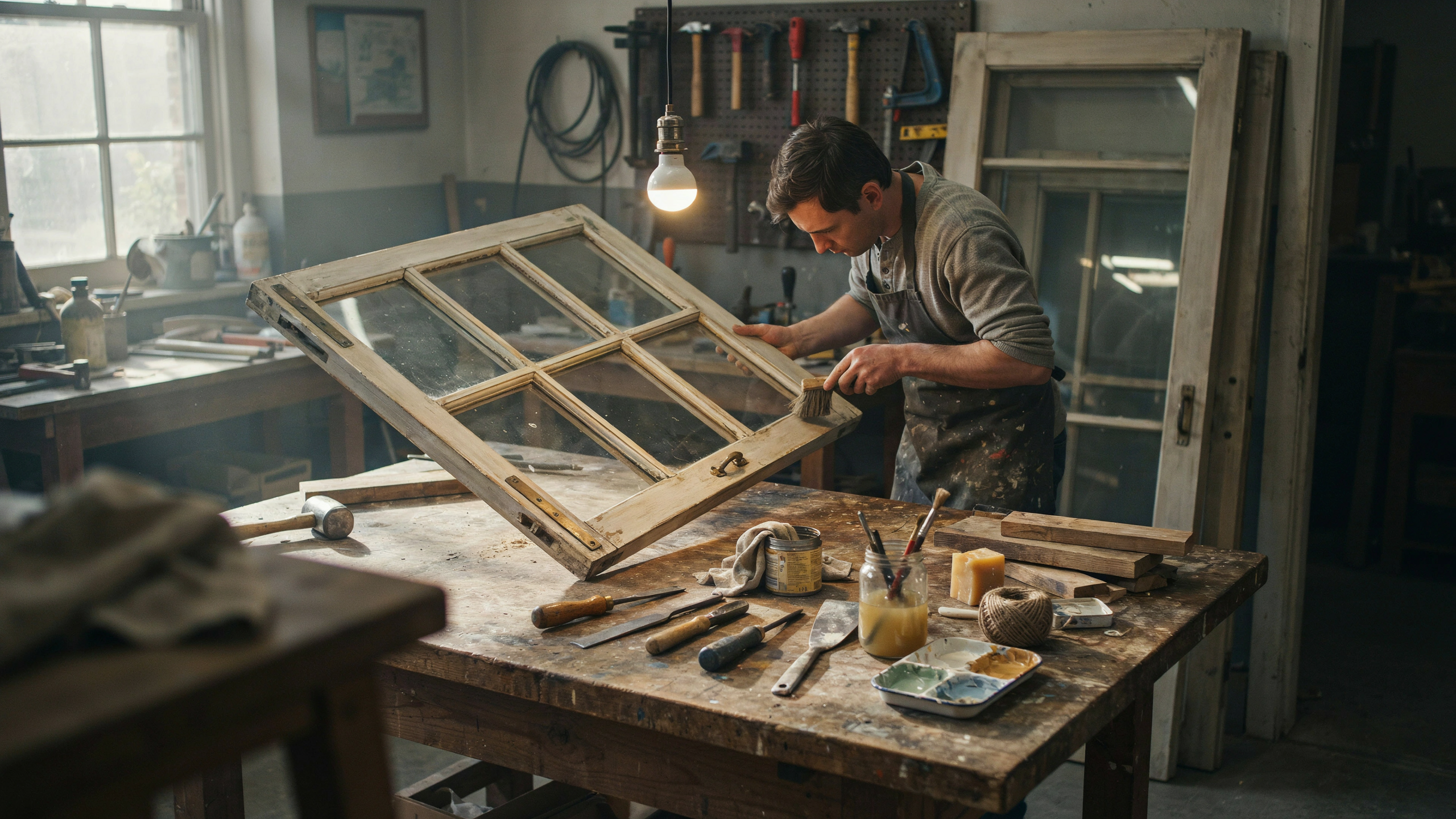
Once a frame is built, it gets a base coat followed by layers of paint that are then sanded back or deliberately chipped to fake decades of wear and neglect. Prop painters will often use a technique called “dragging”, where they pull a dry brush through wet paint to recreate the grain texture you’d find on genuinely old woodwork.
What Goes in the Panes
Real glass almost never ends up in set-built windows. It’s heavy, it shatters in dangerous ways, and cutting it to the irregular sizes that period glazing bars demand is a nightmare. Most prop houses will reach for transparent polycarbonate panels instead, which can be cut to any dimension, take paint and surface treatments without fuss, and won’t hurt anyone if a stunt goes wrong.
Weight is a big deal too. Polycarbonate is far lighter than glass, and that counts for a lot when you’re building a window unit that might need to sit on a wheeled flat or hang from a ceiling grid. On productions like Peaky Blinders and Downton Abbey, where interior sets were studio-built and shuffled around between series, those weight savings on every single component added up to something significant over time.
Ageing the Glass
A fresh polycarbonate pane looks far too clean and uniform to pass as old glazing. Genuinely old glass has slight waves in it, tiny bubbles, and a surface that’s been dulled by years of grime and condensation build-up.
Prop makers have a few tricks. A light misting of dulling spray will give the pane that hazy, slightly milky quality you’d see in Victorian crown glass. For earlier periods, they’ll brush on a thin coat of tinted lacquer and then scratch into it with fine wire wool, which leaves the kind of uneven surface marks that hand-blown glass picks up naturally over time.
Some go even further. They’ll apply false leading using self-adhesive lead strips for Tudor and medieval builds, or gently warp the pane with a heat gun to introduce the subtle optical distortion you’d get from genuinely old glazing. The goal is always the same: make the audience’s brain register “old” without consciously thinking about it.
Dressing the Finished Window
Dressing is the step that takes a well-made prop and turns it into something the audience won’t even register as a prop. Cobwebs, dust, water staining on the sill, flaking putty, a dead fly sitting on the ledge. These tiny details are what sell the age of the piece, and they’re almost always added by the set decoration team instead of the prop builder.
Condensation is another common trick. A fine glycerine mist sprayed on the inside of the pane mimics the damp atmosphere of an unheated period interior, and it catches light in a way that makes the whole window look like it’s been there for a hundred years.
Why the Material Choice Matters More Than You’d Think
When you factor in safety regulations, the need to keep set pieces light enough to move quickly, and the demand for something that actually looks right on camera, polycarbonate ends up being the obvious answer. That’s exactly why it’s become the default glazing material across the UK’s major prop houses. It handles everything from spray paints to heat forming without cracking, even after weeks of rough handling on a long shoot.
Next time you’re watching a costume drama and the light catches a windowpane just right, there’s a decent chance you’re looking at a carefully aged sheet of polycarbonate. Not glass. And that’s the whole point, really. If you noticed it, they didn’t do their job well enough.
